Showing posts with label planting. Show all posts

Tuesday, 26 April 2016

Where there's a willow...

Geese. Water buffalo. Fishing lake. Dexter cattle. Houseboat. Grazing.

In no particular order, all of the above have, at one time or other over the last six years, been suggested as potential "uses" of our acres of wet grassland.

Buffalo and cattle need fencing. Geese need a house and fencing. A lake needs digging and dredging. A houseboat needs a lake, which needs digging and dredging. Grazing needs drainage, which is just digging and dredging in lines rather than one big hole. Ultimately every one of them has the potential to damage the existing eco-system of the grassland. Scrap that, every one of them WILL damage the existing eco-system of the grassland. A damaged eco-system is not good for wildlife, specifically not good for the wildlife that barn owls like to hunt and eat. So ultimately every one of them has the potential to drive away our resident barn owls. And we wouldn't want that!

The upshot of six years of deliberation, procrastination and letting the grassland do its own thing, is that we have decided to let the grassland do its own thing. The difference is that from now on it is going to be a managed do its own thing. To date, doing its own thing appears to have consisted largely of growing willow. So in my untrained and uninformed mind a managed do its own thing would essentially entail managing willow. As luck would have it, Denmark Farm, the conservation centre down the road near Lampeter, had a free willow management course coming up, so I signed David up and sent him off with pen, paper and a packed lunch.

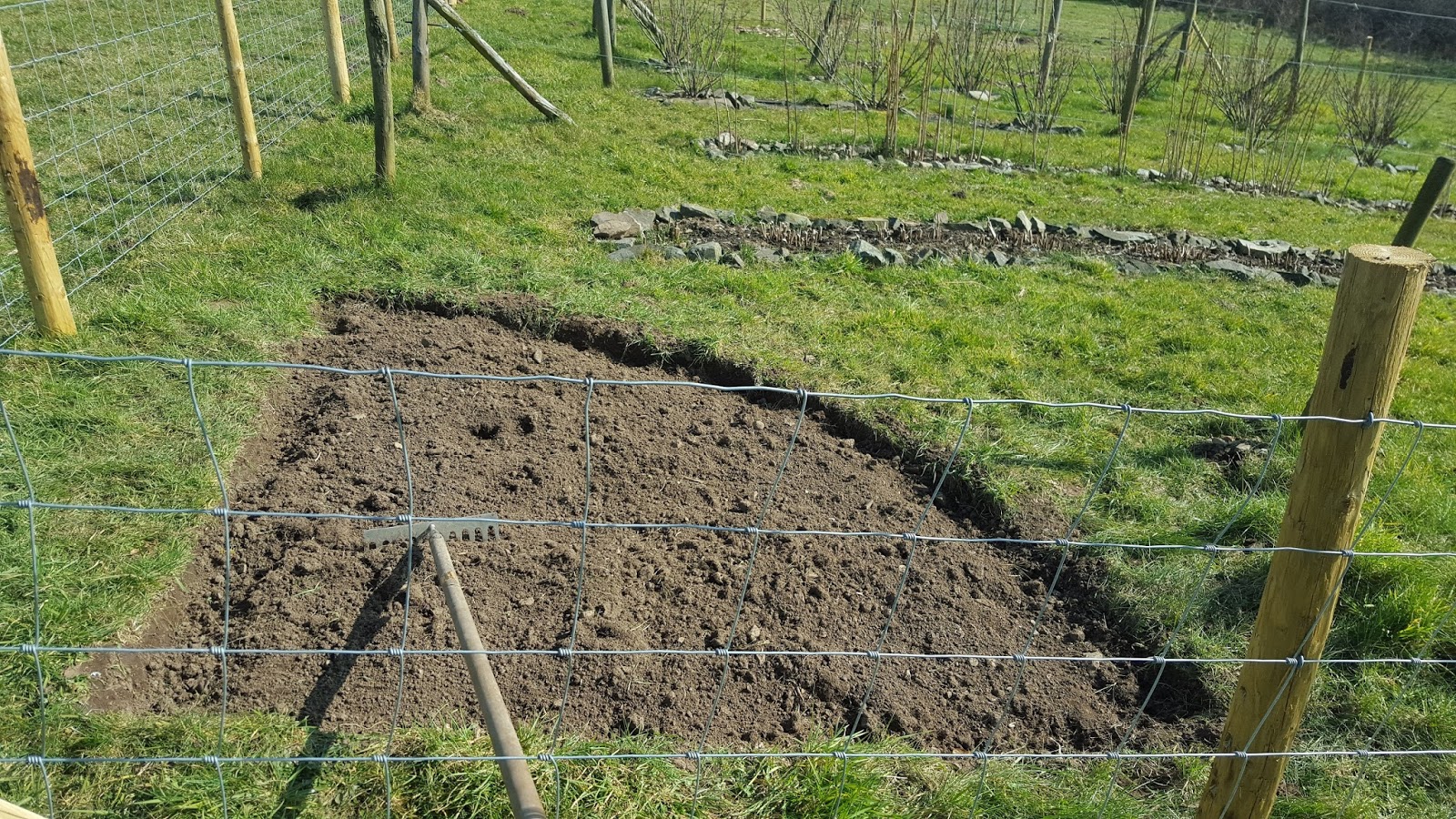
He came back with pretty pictures of pretty things made from willow (leaving me with the need to have a giant woven willow ball in my life). He also came back knowing how to coppice willow. Most important of all, he came back knowing that the willow he had just learned to coppice is completely different to the type of willow growing in our grassland. When is a willow not a willow? When it's the other willow. All was not lost however, for on the course was a man who knew about both willows and, to David's great excitement (we don't get out much these days), this man not only knew what willow we would need for burning in our biomass boiler, he also knew how we could grow it in our grassland. All of which explains why a few weeks later a corner of our grassland looked like this...


Okay, so I realise that black mulch sheeting is no better for the eco-system than a herd of water buffalo, BUT it's only temporary. It also looks a lot bigger in the picture than it is in real life (said the actress to the bishop). When David announced we would be planting 200 willow trees I tried to sound more positive than I felt. The memory of the after effects of using a mattock to dig one hole for one tree lingers still, and it isn't a happy one. Fortunately, when you're talking willow whips, there's a much simpler method. Push them in! BUT in the early weeks and months, the whips don't like competition from weeds and their ilk. Hence the sheet mulch.

David ordered the sheeting before he ordered the willow whips. No surprise then that the sheeting arrived before the willow whips. It was also no surprise that once the sheeting arrived, David just HAD to get it laid down IMMEDIATELY. No waiting for help. No checking the forecast, No checking willow whip estimated delivery date. You have to admire the enthusiasm that led him singly handedly to strim a 400 square metre area of the grassland and then roll out, lay and peg down sheeting of the same dimensions. Such a shame then that the following few days were so very, very windy. Windy enough, in fact, for the sheeting not only to rip out most of those pegs but to then toss aside the breeze blocks and tree trunks hastily put in their place. I envisaged this going one of two ways - either we would wake in total darkness with the front of the house shrouded in black mulch sheeting or the last we would see of it would be a swirling black cloud disappearing over the top of the valley like the giant cloak of a departing, cackling witch. Fortunately, David's diligence shuttling to and fro with wheelbarrow loads of rocks kept it grounded, if a little billowy round the edges. The willow whips which would anchor it properly were delivered a few days later and we were able to plant them straight-away. Well, I say straight-away, but actually there was a short pause between arrival and planting, allowing David to pose as a prone contemplative wizard....


Once that was out of his system and I had stopped giggling, we lugged the bundles of whips down to the grassland (a simple enough sounding task, but fraught with difficulty when I get the heavy end and get the giggles again while traversing tricky terrain). Safely at the location we revealed the whips...


.... and shoved them through slits in the sheeting....


.... all 200 of them ...


.... and then found the planting instructions at the bottom of the packaging. Hey ho, they're not dead yet though, so fingers crossed (and assuming that the willow man knew what he was talking about and wasn't just spinning a yarn, or perhaps weaving a willowy tale) in four year's time we'll be coppicing a year's worth of fuel.


Thursday, 21 April 2016

Ask (suggest) and it shall be done (sometimes)

There's neither rhyme nor reason as to why an idea to do something pops into the head on any given day. There's no logic as to why that something has taken six years to pop into the head when it is something that could just have easily been done six years ago as last week. For example, Hen Ffermdy cottage has had bare stone walls for six years, nothing has changed in that period, and as of last weekend it still had the same bare stone walls. At any time I could have looked at those walls and said to myself, "that looks a little bare, I wonder if there's a plant that could be trained to grow up that wall". But I didn't. Until last week. Perhaps the idea has always been there, but buried at the bottom of my useful thoughts pile, lost until now in the jumble of less than useful thoughts, distractions and general nonsense which swirl around my head on a daily basis. Grasping the thought whilst it was still bobbing along the surface of that swirl, I went out and bought a clematis and a very big pot.

I returned home feeling pleased with myself. "That's going to need a trellis", said David. "Did you buy one?" Faced with a return trip to the garden centre and making another purchase, I felt less pleased with myself. "Can't you make one?", I replied after a short pause. Feeling pleased with myself once again, I trotted off to potter in the polytunnel. I knew the seed had been planted, not in raised beds, but in David's mind, and all I had to do was wait for it to germinate. As plant germination rates vary, so do project germination rates, except project rates can be anything from days through to months and occasionally years, though in that case it is usually safe to conclude that the seed rotted away for lack of t.l.c. and the project will never see the light of day. The seed for the trellis project was one of those extremely rare instantaneous germinations. Within the hour David was scouting the land for suitable tree whips. A short time later, still in the polytunnel, I could hear tap, tap, tap, woof, woof, whine. Tap, tap, tap, woof, woof, whine. Yes, David was hammering, Teri was helping.

Strolling back to the house with an armful of rhubarb for tea, I spied David by the woodshed. I went to investigate. "I've done it!", he declared. Sure enough, he had. Pleased as punch, he held his creation aloft. A trellis. Not just a trellis, a fan trellis. A rustic fan trellis made of ash whips. More befitting of Banceithin than anything I could have bought for silly money from B&Q.


Saturday, 26 March 2016

Stony Faced

It was near as damn it exactly 7 years ago yesterday that we created the raised beds that became our veg plot. It was 7 years ago last month that we created the trenches that became the poly-tunnel. Come December, it will be 7 years ago that we created the five rows and ten holes that became the soft fruit patch. All of these were bare soil reclaimed from a grassy, weedy field unloved and unfarmed for a good long while. All of these required hours of hard labour, digging, raking, sieving. How then could I possibly have forgotten just how stony, and I mean really seriously stones galore stony, our land is!

Once upon a time we had a wild flower garden. It lasted one summer. One glorious flower filled colourful summer. Then the chickens started free ranging. And the grasses and the docks and the nettles moved back in. All that remains is a small patch of comfrey and a border of rose bay willowherb, and the latter only there by accident, the seeds parachuted in from elsewhere like emergency reinforcements as the seed heads of the front line flowers fell victim to scratching greedy chickens.

There have been other experiments with wild flowers over the years. The seeds scattered around the new pond produced a one off bonanza poppy display not seen again until last year, some 4 years later, when a smaller but equally impressive display flowered 6 feet away from the original flowering site and INSIDE the poly-tunnel. Meanwhile, the annual pond display now consists almost entirely of red and white campion. Beautiful and bee-friendly as they are, neither were in the flower mix we sowed.

Undeterred by our track record, spurred on by the plight of our forage hungry bees, we've begun another wild flower project, optimistically trying to learn from past mistakes. David did the hard graft of removing the turf, leaving me with the delight of returning home from a day at work to find a corner of the fruit patch transformed into a flower bed with a curve so shapely I felt the need to wolf whistle.


All I had to do was follow planting instructions to "dig over the bed to the depth of the tines of your fork and create a fine tilth". If my fork had been half the size it actually is, everything would have been fine and dandy. As it was, my first attempt to sink the fork tine deep was met with a stony thud halfway. Move the fork a little to the left, try again. Thunk. Move the fork a little to the right and behind. Thud. It was at this point that all those hours, 7 long years ago, of digging, raking and sieving came back to me. As I said at the start, how could I have forgotten!

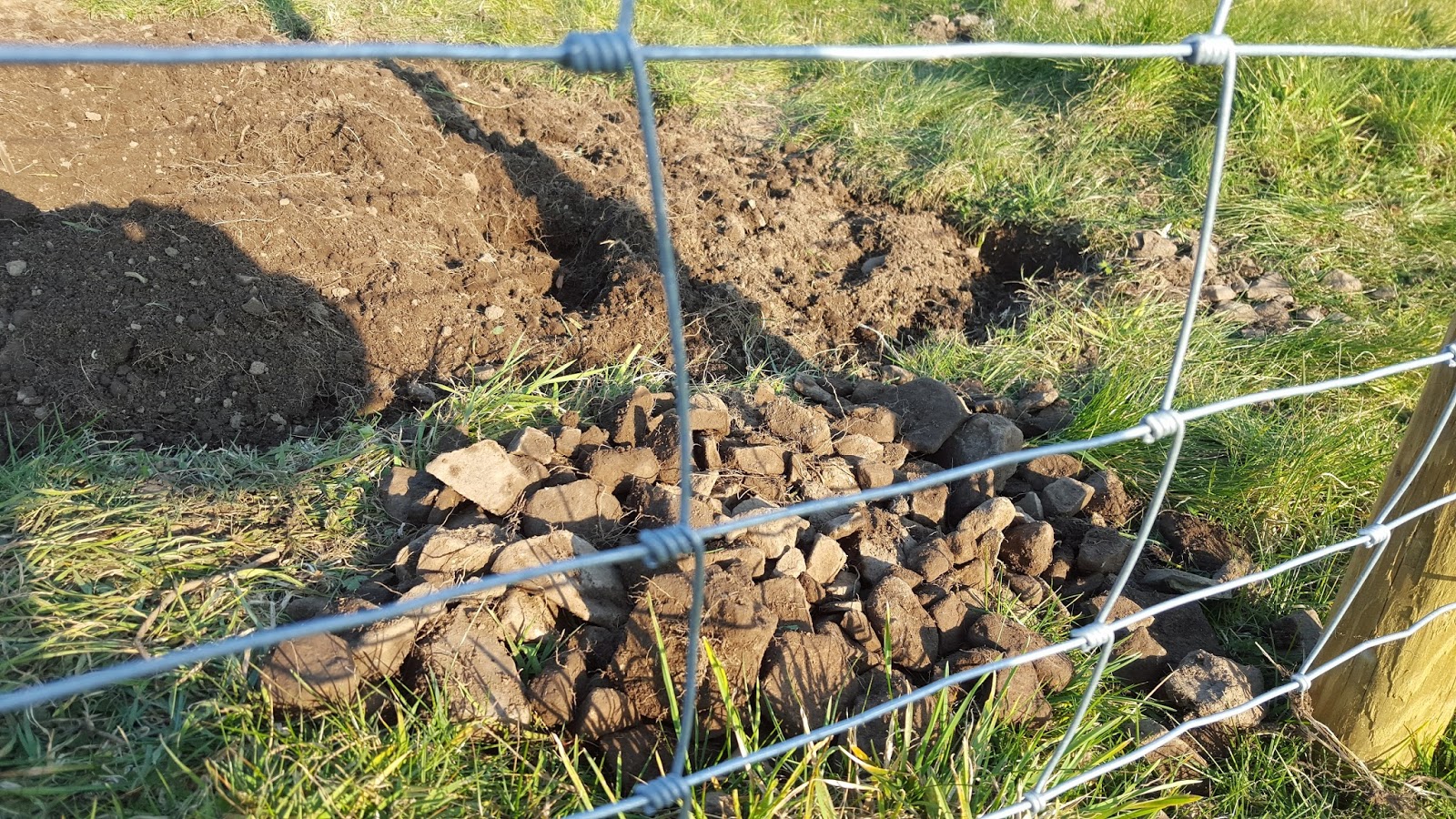
Two hours, a setting sun and four piles of stones later, my flower bed had a sort of definitely not fine but fine enough for me tilth, my hand had a blister and my back muscles were in need of a soothing Epsom salts bath.


The sun continued to shine that week, warming the top layer of soil to a seed cosy temperature, so we broadcast sowed the seed mix. Seeds are fascinating little bundles of botanical magic waiting to explode into floral fireworks. The closer you look, the greater the detail there is to see in their differing shapes, textures and colours, and yet none of that detail can be extraneous as Mother Nature is not generally frivolous for frivolity's sake. My seed mix included fairy paint brushes (or hairy legged micro squids), teeny tiny eggs, fossilized spiky baby slugs and beetle body husks.


The packets promise that this unpromising looking medley will one day be cornflowers, borage, buckwheat, calendula, phacelia, corn poppy, hyssop and crimson clover. I yearn for that day.


Wednesday, 14 January 2015

Science Lab

David is unhappy with his leeks. He's been unhappy with his leeks for weeks. They're thin, They're short. They're not growing. He loves his leeks, and they're a vital crop to for filling the winter hungry gap. His concerns are no longer allayed by my reassurances that Atlanta is a late developing variety for harvesting December to April, and deliberately chosen by me for that very reason. It's January. Some of the leeks are still little more than fat pencils. The variety is no longer an acceptable excuse for poor performance.


He maintains the leeks were transplanted too late. My (admittedly defensive) response as Chief Plot Planting Planner (not an officially accepted title) is that as we only have one onion bed in the crop rotation, the leeks cannot go in any earlier than the garlic comes out, and the garlic cannot come out any earlier than when the bulbs are ready or we might as well have not planted them in the first place. See how I used inescapable logic here. He maintains that the soil is to blame. Too acid, he says. My response is "so test it then". Not defensive at all really. I found the as yet unused soil testing kit in the cupboard, placed it in a strategic position in full view of anyone passing through the utility room and waited. A few days passed and I put it away again. Nothing more was said about the leeks. Unfortunately nothing more appeared to be happening in the leek bed.

To be fair to Dave (which I always am, of course), it wasn't entirely beyond the realms of possibility that he was right about the acidity. When we bought Banceithin the land hadn't been farmed for years, and the field we'd ear-marked for the plot and polytunnel had certainly never been used for vegetable and fruit growing. We had the soil tested, sending plastic bags of soil samples off to the Royal Horticultural Society Soil Advisory Service (yes, I know, very posh). According to the soil boffins our soil has acid tendencies (probably due to proximity of the bed rock, i.e. we've hardly any top soil) and a potassium deficiency (probably due to a lack of bananas). Whilst we diligently followed the boffin advice for liming and feeding the soil before creating the growing beds, that was six years ago. That six years is a full cycle of our six year crop rotation, and while that is six year's worth of us putting in manure, compost, fish blood & bonemeal, seaweed, egg shells, comfrey tea and our own highly nutritious blood, sweat and tears, not to mention digging out boulders, picking out stones and flicking out the occasional cat poo, it is also six years worth of roots, brassicas, onions, potatoes, legumes and salads sucking out nutrients.

So David turned soil boffin and set up his lab on the dining room table. Soil samples were collected, the little piles in the ice cream tub carefully labelled, and placed on the boiler to dry. Then came the science. Everyone loves a test tube and an acid-alkali colour chart. Mix in the magic soil testing fairy dust, give it a shake, and wait. Hey presto, the leek bed is too acidic.


Interestingly (well to us anyway), from the middle of the field and the start of our veg plot where the acid-alkali level is roughly neutral, the acidity gradually increases across the beds and towards the poly tunnel. More interestingly, the performance of our potato crop, a cultivar with a preference for acidity, dropped off as its planting position moved in the reverse direction. Well what d'you know, there really is a correlation between soil quality and crop performance. Obvious perhaps, but it's always good to see the science confirm it.

None of this is of any help to this year's leeks, which have to remain lying (or rather standing) in their overly acidic bed even if they didn't make it themselves. David will have to remain disappointed, but at least he now has an answer and I no longer have to come up with excuses.


Tuesday, 11 November 2014

From Poly to Plate

It was Hallow'een. I was in the mood to be amazed. I was feeling ropey after a turbulent night arguing with a dodgy prawn (or at least that's what I thought it was at the time, though it subsequently turned out to be one of it's more deadly relatives, the winter virus). Feeling weak and feeble and very sorry for myself, I was gazing blankly through the window watching leaves fall outside in the garden of my parent's house. I needed something amazing to happen to lift me up out of my funk. Water and glucose energy tablets weren't doing it for me. 

A red admiral butterfly fluttered by. That was pretty amazing for the time of year. But having read an article in the morning paper about the many sightings of the red admiral throughout October, my amazement was somewhat diminished. Unfair to the butterfly. Blame the media. A large dragonfly made its staccato flight left to right across my view through the window. That was definitely an amazing thing to happen on Hallow'een. And all the more amazing for not being an event my morning newspaper had told me to expect. 

I realised that I wasn't seeing the bigger picture (clearly my inner philosopher is roused from her slumber by a dose of the runs and a morning spent in sporadic prayer to the porcelain God). My self-indulgent, woe is me, entertain me, dance for me, state of mind was clouding my vision. Everything I saw through the window that morning was amazing. It's amazing that nature in myriad forms was out there to be seen and, dicky tummy aside, that I was there at that point in time in that spot to see it. The more you look, the more you see. A white-tailed bumble bee was foraging in the begonia. A common carder bee emerged from the trailing lobelia. The bees were still flying - amazing! The flowers were still flowering - amazing! And then I started to think about tomatoes. I had my phone in my hand and I happen to have a lot of photos of tomatoes on my phone, so that wasn't as great a leap of imagination as you might think. I'm sure that every smallholder has a photo gallery consisting mainly of fruit, vegetables, animals or food in varying stages of growth or consumption, but it's possible that this condition is specific to me. But back to the tomato .....

We grow tomatoes in our polytunnel every year. Each plant starts its life in March as a small seed. It's no bigger than a piece of fluff from a belly button. We give it a bed of damp, organic, peat-free compost and a warm spot on top of the biomass boiler. Three, sometimes four or five days later a seedling appears, its head bowed down by the seed case that it wears like a tiny crash helmet. The temptation to free the cotelydon leaves from this burden is great, but we leave the seedling to bear the weight so it can grow strong and healthy in its own time as nature intended. Before too long we have a whole tray of seedlings, a mini-forest on our kitchen windowsill. The three inch tall seedlings are lovingly pricked out, held aloft by the lightest possible touch on their delicate first true leaves, and with a few words of encouragement and some apologies for the disturbance, each is eased gently into its own little pot. It's at this point that failure to label each pot can be disasterous. How else will you know pre-fruiting whether your plant is a Matina or a Saint Pierre, or a Zuckertraube or a Costoluto. Examining plants for minute differences in leaf shape is no substitute for good labelling.


Every spare windowsill is now home to tomato plant. We allocate responsibility between us to ensure that at least one person remembers to tend the plants in each room. At this point we have to hope that the point at which the plants hit 6 inches tall and their roots fill the pot, corresponds with a warming of the weather. We check the forecast daily, trying to assess the risk of late frost, as even in the polytunnel the plants can take a potentially fatal knock-back if the temperature plummets overnight, but once they're settled in their final growing site the real magic begins. Manure, water, stinky comfrey tea, warmth and sunshine are the fairy dust. The plants grow, and grow, and grow some more, until that tiny seed is a four foot high plant laden with trusses of tomatoes, a cascade of green, yellow, orange and red. Now that's amazing!


And do you know what's more amazing? The smell of a bowl of warm freshly picked tomatoes. Bury your nose in it and breath deeply. Everyone says this, but it's true, it's a bowl of sunshine, sunshine that can be sliced, drizzled with oil, sprinkled with basil and munched for summer lunch, or roasted, mushed and stashed away for a taste of summer on a rainy November day like today.


Thursday, 10 March 2011

Another year, another spring

The Twitterati are busy twittering about the signs of spring and I’m seeing photo after photo of flowering daffodils, nest building birds and trees in full leaf. As usual, our West Wales valley microclimate is at least two weeks behind everyone else. Those daffodils whose heads have not been munched by an as yet unidentified night time beastie, are keeping their flowers tightly wrapped up. The blue tit, star of our “Tit in Residence” short movie, has stolen all the straw out of our best box and disappeared, and is no doubt busy constructing a straw lined palace in someone else’s garden.

Here at Banceithin, you know it’s spring when:

- The first attempts are made to go cold turkey and spend a full 24 hours without thermal long-johns or thermal vest and only one pair of socks.

- The central heating thermostat is knocked down another notch (not by me) on the argument (not mine) that if we open the front door the spring sunshine will warm the house instead.

- The cats are forced to share the windowsills with trays and pots of potting compost and the most asked question of the day switches from “any bookings?” to “any germinations?”.

IMG_5710

- The cobwebs, twigs, leaves and bird poo are dusted off Trinny the Tractor because it’s sunny and Dave just can’t wait to bounce around the fields again.

- Froggy goes a-courting, sounds of amphibian loving fill the air, the murky water behind the shed turns to jelly, and the occasional squashed frog turns up on the drive.

IMG_5672

But there really is only one sure sign that spring has sprung, that the sap is rising and that winter really is behind us.

Dave starts a new “project”…..