Showing posts with label sheep. Show all posts

Friday, 21 April 2017

Therapy

In one hand is a bucket of pig nuts. In the other a bucket of ewe nuts. Tucked under one arm is my gardening kneeler pad. The mobile phone is in my pocket. If I had another hand I'd be carrying a mug of tea, but animal breakfasts always come first. The metallic scrape and twang as I pull back the gate bolt sets off the bleating. The bleating sets off the squealing and grunting. Wriggling weaners at my ankles, I throw pig nuts in the pig trough, losing at least a handful to the mud as nuts bounce off the heads and bodies now in the trough. Keeping the other bucket held high out of reach of Babette's greedy mouth and moving swiftly enough to keep myself out of reach of her front hooves, but not so swiftly that the lambs get left behind, I cross the field and throw the ewe nuts into the sheep trough. Feeding done, I do the round of water buckets. Watering done, I drop the kneeler pad to the ground, pull my hood up to protect my ears and neck from the nipping wind, pull out the mobile ready for a close up shot, plonk my butt on the kneeler pad, and wait for the lambs to put on a show. Bounce, bounce, bounce. A daily dose of lamb play. This is my therapy.

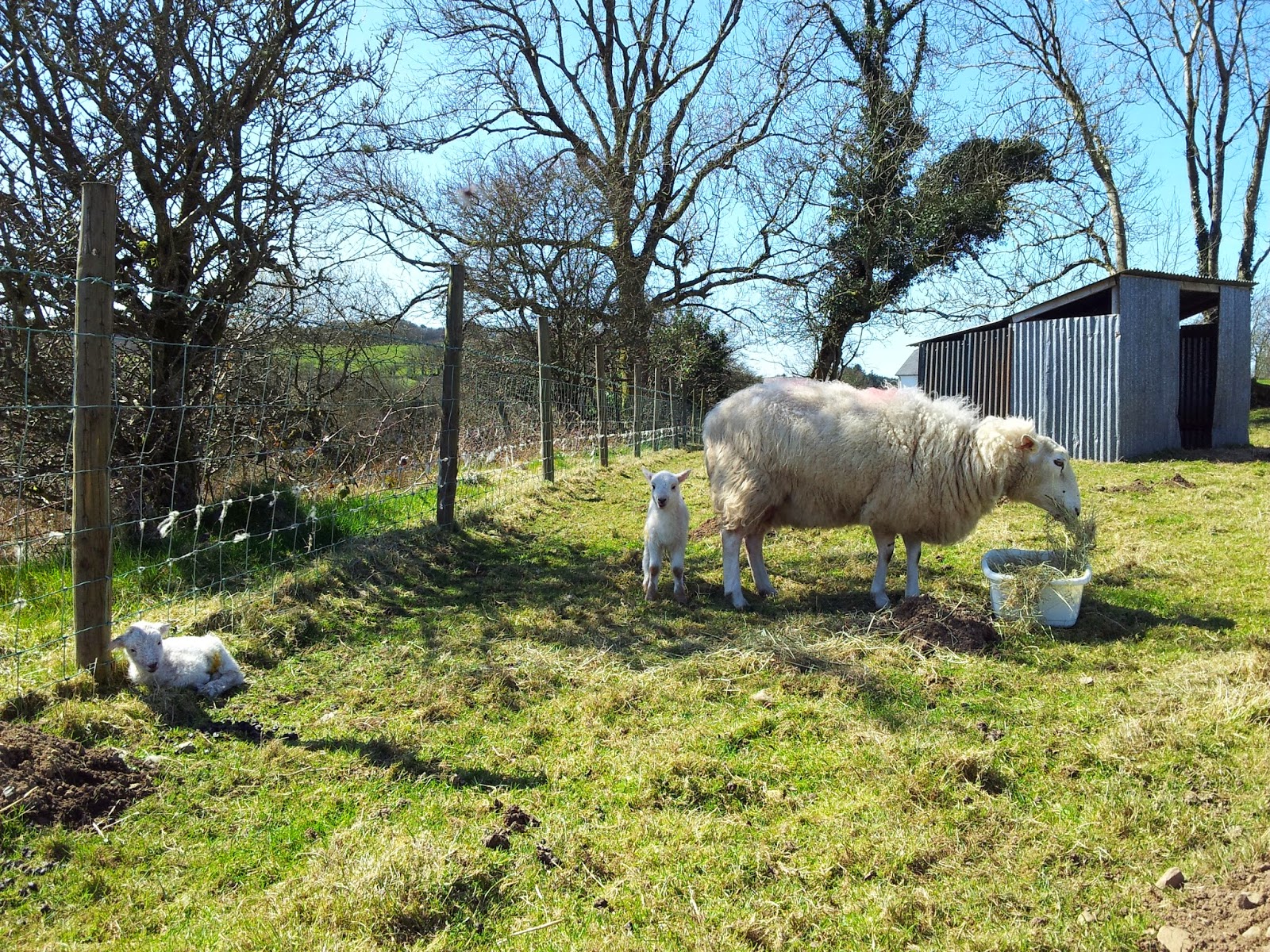
The older lambs, Bobby, Betty and Bonnie, now nearly two week's old, are the boldest, and their experienced mums, Babette and Babs, graze unconcerned, giving the lambs the freedom to chase, hump (each other) and jump. The younger lambs, Jake and Florence, really want to play too, but their mums, Bychan and Pascale, keep the apron strings tighter. Given that both are first time mums and both had difficult first time lambing experiences, their reluctance to "let go" is perhaps understandable. For the first few days after lambing neither would allow either of us anywhere near them or their lamb, heading determinedly in the opposite direction each time one of us came into sight. Hardly surprising - big lamb, small exit, long labour, hands in, messy birth, stabbed in the leg with a needle, enough said. Both have now regained their composure and dignity, so I can sit in the field with the flock once again, observing their behaviour, keeping an eye out for signs of fever and infection.

A game of chase

Pascale won't allow Florence to stray too far from her side, following Florence when she bounds towards the other lambs, intervening and guiding Florence away after a short play. Bychan goes a step further, not just following and intervening, but actively head butting the other lambs away from Jake. I've seen similar behaviour before, often by Babs if lambs of other ewes get between her and her breakfast, or between ewes when the pecking order needs to be re-established, but Bychan's instinct to protect her lamb can be noticeably more aggressive. The other day Bobby & Betty led all the lambs on a chase into the sheep run. Bychan followed and cornered them all at the end, against the fence. She nosed Jake, her own lamb, to her side, then turned on the others. All but Betty nipped round Bychan and got out, but Betty tried to escape by going through the fence, getting stuck at her shoulders. At this point Bychan turned nasty, continuing to butt Betty. Fearing Bychan would break Betty's neck, I jumped up to intervene, bouncer style, but Betty yanked her head back and out of the fence, and scarpered sharpish, going straight to mum for a comforting suckle. No harm done this time, but Bychan needs to chill out soon or risk being separated. And then who would Jake play with?
Bychan and Pascale turn to intervene as Babette, Bobby & Betty approach Florence and Jake

Babs & Bonnie waiting for the ewe nuts bucket to arrive!


Friday, 14 April 2017

Beginning with B

It started with the chiff chaff. It always starts with the chiff chaff. Followed by the cawing of the jackdaws carrying down the chimney and echoing through the fire place into the front room as they once again set about stuffing twigs, moss and general detritus down the chimney pot for their nest. Last week David heard the reeling song of the grasshopper warbler. A few days ago, as the sun shone strong and warm, I saw my first orange tip and red admiral butterflies. The white and buff tailed bumblebees are so abundant and busy that you have to be alert to the buzzing for fear of a head on collision. A pair of mistle thrush regularly have a noisy chest off with the magpies residing a few trees away, while another pair have set up home hidden in the tangled depths of ivy enveloping one of the ash trees in the corner of the sheep field. Their new neighbours appear to be the wheatears, but a more reliable identification with binoculars is required, instead of an "is it, isn't it" identification through two pairs of squinting, ageing eyes. I know the swallows have returned down the road at Pennant, but so far no sign of them here at Banceithin. I'm watching. I'm waiting. For swallows. For housemartins. For the cuckoo. For a lamb.

Lambing has been the usual waiting game, although this year the twin technologies of scanning and crayon have at least narrowed our watch and wait window to a workable two weeks as opposed to the long drawn out six weeks of lambings past. There is a pronounced path across the field in a diagonal line from the gate by the house to the stile in the corner. To and fro. Checking. Feeding. Watering. Last Friday, Babette did her usual trick of slipping out twins early, unseen and unaided, presenting us with two licked clean lambs at the morning feed. A ram lamb - Bobby. A ewe lamb - Betty. Babette, Bobby & Betty. A lovely family trio. 


The ram had clearly been having a good day because within the hour, in the time it took me to go back to the house for a quick breakfast and return to check Babette, Babs popped out a single and immediately set to work cleaning her up. Usually when the umbilical cord breaks as the lamb leaves the ewe, the "tail" left at the lamb's navel is short, about 2 inches or so, or if it's longer the ewe might nibble it shorter. Babs, however, left her new born with a two foot long, dark red, slippery monster of a "tail", as thick as a finger at the navel. Standing for the first time within minutes of birth is miracle enough, so to expect this lamb to do that with an umbilical snake tripping her up at each attempt was too much. Tap, tap, tappity tap on the internet forums ...... carefully tear it away at the correct length was the advice. Yikes! A smallholder is never too experienced to face another new experience! Pinching the cord tightly closed with one hand, David pulled away the rest of the snake. Yuk. That felt instinctively wrong. But a quick spray of iodine, back to mum, and she's up and suckling straight away. A bonnie wee ewe lamb with floppy ears. Bonnie. The miracle of life.


Saturday, 21 January 2017

It's twins!

You know how it is, you think you're pregnant, you eat for two, turns out you're not, and now you're a fat ewe. No? Babs does. She knows all too well where eating for two but being one gets you. I believe the technical, and perhaps unkind, terminology is "big old unit". In truth she isn't entirely to to blame. In truth, she isn't to blame at all. We are.

We've never scanned our ewes after tupping. Who would be prepared to hike out here to scan just three or four ewes? Not cost effective for anyone. So we've always relied upon the "signs of pregnancy". This is not, however, a fail-safe form of pregnancy testing. And there is no way of getting a ewe to wee on a stick. Unless it happens to be lying underneath her at exactly the right moment. But those aren't the right sort of sticks anyway. The problem was that last year neither of us could agree if Babs was pregnant. I spent A LOT of time on hands and knees, lurking behind, below and alongside her, trying to spot sticky outey nipples under her all encompassing fleece cloud. I was sure she was pregnant. David said no. I was wrong, he was right. Don't you just hate that. She was faking it, enjoying four weeks of supplementary feeding at our expense. And thus, she became an enormous cloud with legs and a face.

This year we decided that this could not happen again. Not good for our bank balance. Not good for our ewes. Some tip tapping on the keyboard later and we found our saviour, Mr West Wales Scanning. No flock too small. No ewe too big. There's always a downside, and that came in the form of fitting us in while he's en route to bigger better and more financially lucrative flocks, meaning an early start in the dark. I am so not a morning person, but every time I drag my sorry backside out of bed as the sun rises, it's worth it ....


The fleecy ladies had a rude awakening, but Mr West Wales Scanning had an excellent bedside manner; "this will feel a bit cold" (no kidding, the outside temperature was still below zero, so goodness only knows what temperature the lubed probe was at). Who was he telling? Me? I winced in empathy. Babette was up first. Fumble. Pause. Baited breath. Announcement. Twins! Man handle the flock. Moment of disaster averted as an errant lamb gets tangled in the scanning kit. Bychan, first time mum, next. A single! Pascal makes a bid for freedom. Almost lost her in a gap in the hurdles as I was momentarily distracted by trying to get a photo for the blog, this blog. Back in control, fumble, pause.... a single! Last but not least it's Babs' turn. Her last chance saloon after coming up empty last year. She's 7 years old. Has she come the end of her productive life? I hold my breath.... a single! Hooray for Babs! So that's five potential new lives to look after. How to celebrate? Why, with hay of course! 


Sunday, 7 February 2016

Second Chances

Myfanwy has had more second chances than an unproductive ewe with an attitude problem could ever hope to get if she lived on a real farm, run by a real farmer trying to make a real living out of the real farm. She's had the attitude from day one. Always the one refusing to enter the pen. Always the one when penned who jumps over the hurdles and escapes the pen. It's because of Myfanwy that we had a permanent high fenced pen built. Better that than have her break a leg, and in her time she has come too close to that for comfort.

Being unproductive came later. She had her first lamb, Ceredig, when she was a 2 year old. Ceredig was born without a problem and Myfanwy was a good mum. The following year she returned from tupping empty. That was the point at which many would have sold her as a cull ewe, destined to become a twirling elephant leg kebab. Not us. That was the point at which she got her first second chance. The following year, aged 4, she aborted the foetus nine weeks prior to lambing. A bloody tail. No great trauma. Outwardly no ill effects or change in behaviour. Myfanwy just carried on as normal, including the attitude. That was definitely when everyone else would have sold her as a cull ewe. That was what we decided to do. She escaped at the first sign of truck and trailer coming across the field to collect her. Weeks passed before she would once again go anywhere near the pen. And so we all just carried on as normal. That was her second second chance.

Knowing that Myfanwy could still get pregnant, I convinced myself that the abortion was the dog's fault, that Teri had somehow spooked Myfanwy with her erratic, lunatic dashing around the pig pens. So she got a third second chance. At nine weeks prior to lambing, almost to the day of the previous year she aborted the foetus. Again, no trauma, no sickness, just business as usual for Myfanwy. The second abortion made me immensely sad, for there could be no more second chances for Myfanwy. The continuous wet weather from November, through December, on in to January, and now February, has been proof, if proof were still needed, that we have insufficient grazing to support a larger flock. Keeping Myfanwy as a pet (with attitude) and companion ewe for lambs separated from ewes is not an option. Even if we could keep her, culling would be the end game as letting an old ewe with teeth incapable of cutting and chewing slowly starve to death is very much not an option.

It was market day in Tregaron last Friday. On a good day, a large ewe like Myfanwy could fetch up to £80 from one of the large kebab hunting companies that trawl around local markets in search of suitable meat. She didn't fetch anything like that. Not a penny. She wasn't there.

I thought about the money we could make from her. I thought about how I'd felt when we took Rhos and Lulu to market last year. I remembered that those feelings weren't good, not good at all. I couldn't reconcile myself to what would happen to Myfanwy after I walked away from the market, what did happen to Rhos and Lulu. This wasn't why we became smallholders. This isn't why we keep animals.

So it's now Sunday morning. Very early tomorrow morning Myfanwy will be going with two of our lambs to Tregaron abattoir. We will take her. We will see her walk in. She will be killed and butchered to our requirements by a butcher whose name we know and who we can talk to face to face about our animals, who will give his opinion on the quality of our animals, who knows what we do and why we do it. We will collect the meat. We will learn all there is know about how to cook mutton. We will enjoy mutton bacon for breakfast. We will make amazing curries for dinner. That is how it should be. That is why we became smallholders.

All we have to do now is get her in the pen.........

Myfanwy in the shed on the day of the birth in 2013 of Ceredig, her one and only lamb


Sunday, 3 January 2016

New Year, Same Old Ewe

We squelched our way through the end of last year, and it's a soggy start to the new one. We have mud where we've never had mud before, including, thanks to the three amigos and Teri, in the house. We have standing water where we've never had standing water before, including, to the detriment of leeks and garlic, in the raised beds. Our best draining and only grazing fields are a sodden, sheep trodden mess. The tool shed has become a sponge. The solar panels have given up waiting and shut themselves down for the first time ever. The streams have over-flowed and receded so many times that most of the driveway stones must now be on the beach down at Aberarth.

  Yet as rain continues to fall there is much for which to be thankful. We are not sweeping water out of our home. We are not throwing out sorry looking piles of water damaged furniture and belongings. We are not waiting for receding flood waters to reveal the heartbreaking sight of drowned livestock.

  Our lambs stare at me forlornly from under their mud streaked rain soaked fleeces and our ewes have a look of resigned dissatisfaction at the unending nights spent sheltering in the hedges, but at least they're alive to be counted in the annual inventory required of us by the Animal Health Office. Completion of this paperwork every January never fails to raise a smile. We are required to count our flock and report back with recommended dates for inspection, being dates when we bring the flock down for clipping, shearing and the like. On most days of the year I need only stand at the gate and rattle a bucket to be able to head count our entire flock (unless of course some silly billy has got herself tangled in brambles again). But it seems that when it comes to DEFRA paperwork one size fits all, whether you're a smallholder with a single pet sheep or a farmer with a flock of 300. So once again I tick the boxes, dutifully submit the statistics of my flock of eight and await the visit of the man (or woman) from the Ministry.

Sunday, 5 July 2015

Shear hard work

"It's not as easy as it looks." Massive understatement. Huge.

One of David's many admirable qualities (tongue firmly in cheek) is his 'can do' attitude. If something isn't working as it should or at all, David won't rest until he's fixed it, or on the rare occasion that he can't fix it (tongue still firmly in cheek), until he's found someone who can, or if he can't find someone who can, until he's figured out a way around the problem, more often than not in what he calls his 'Heath Robinson style' (i.e. complicated machinery achieving a simple objective) but which I believe could more accurately be described as a 'reverse Heath Robinson style' (simple solution to a complex problem). Unfortunately there are times when the 'can do' attitude encounters a 'can't do' situation. Like sheep shearing, for example.

It's the 'can do' attitude that buys the shearing clippers.

I didn't prompt David to make this purchase. The decision to take on the shearing of our sheep himself was entirely his own. I questioned the decision. I was accused of (and confess to having) a lack of confidence. I suggested perhaps he ask one of the local shearing lads to help with the first attempt on a live animal. If he really could take this on then when fly strike season comes round each June there'd be one less thing to worry about, one less thing to be dependent upon others to do. The memory of dealing with fly strike in Rhos and Lulu last summer is certainly a motivating factor here.

Obviously the first thing to do before putting clippers to fleece is to go to the pub for a briefing. There's nothing worth learning that you can't learn how to do at the Rhos Yr Hafod. The down side of this is that everyone now knew that David intended to try his hand at shearing. Many asked for the video to be posted on YouTube. Most usefully, however, we also had a back up plan in the form of an offer to help, and from no less a local dignitary than John, dairy farmer, shearer extraordinaire and the owner of the pub to boot. But then when has our local community ever not offered to help. Have I ever told you how lovely everyone here is?

Anyway, back to shearing. I was at work on the day of the first attempt. In my absence, David and John spooked my flock and only managed to pen Babette (the greediest and therefore up for anything if food might be involved). John sheared. David watched. The clippers never went anywhere near David's hands. However, inspired by the ease with which John sheared Babette, the next morning we penned all four ewes and the six lambs and with 'can do' attitude intact David announced that he'd shear the lot without help. Go David!

Twenty long, hot, sweaty, exhausting minutes later, Bella had the world's most embarrassing back end hair cut and an equally exhausted panting Babs trailed partially shorn fleece from a sort of shorn hind quarter. What took place was not sheep shearing. It was sheep wrestling.


In David's defence, much of his confidence drained away after an early nick to Babs' back leg bled onto the shearing board. Despite my repeated reassurances that she was not in need of the crash cart, he swore he could feel the blood "pulsing" out of her. Nor did it help that it was the hottest day of the year so far - what I thought was blood dripping onto my hand turned out to be sweat dripping from David's nose. I was no mere bystander either. At one point, with Babs wedged awkwardly between his legs, David couldn't get his right hand in position to shear, meaning control of the clippers was passed to me. Desperate times call for desperate measures. Yet even a ratio of two shearers to one sheep couldn't rescue us from what rapidly became the dreaded 'can't do' situation. Clippers were downed pending arrival of the shearing cavalry. John only had a spare 5 minutes between 'proper' shearing jobs, but that was all the time he needed to tidy up Bella's bum, do five more lamb bums, finish off Babs, and shear Myfanway and Margo. And then he was gone, leaving us standing in a pen of bleating naked sheep surrounded by bits of fleece, dazed at the speed at which it all happened, and David dejected and disappointed at being defeated.


On the plus side, at least we gave everyone something to laugh about back at the pub. And don't worry about David, he soon bounced back. The 'can do' attitude is currently researching shearing courses for summer 2016.

Thursday, 28 May 2015

The Mart

Sometimes there's absolutely no point whatsoever in pretending you know what you're doing, and Tregaron livestock market is definitely one of those times and places where you'll never get away with it.

We'd been given a blow by blow account over a beer or two in the pub of how our morning at the mart might unfold; when to arrive, what to say to the auctioneer and when - "I'm disappointed", "on the market" - what sort of price we might expect, who would buy our stock, what to order for breakfast in the portakabin canteen. Despite all this, the day didn't start as planned when Myfanwy hurdled the hurdles (yet again, when will I learn), signing Lulu's death warrant in the process. Two sheep had to go to market and neither Lulu or Rhos had yet to develop Myfanwy's leaping skills or sense of self-preservation, so when three became two in the pen by default Lulu had to accompany her half-brother to market. This unplanned turn of events left me a little tearful. I'd said my goodbyes to Rhos and Myfanwy and mentally prepared myself for their departure. Myfanwy had been nothing but trouble for the past year, but Lulu had never put a hoof wrong in her year on the smallholding. Nevertheless, a change of plan is a change of plan whether I like it or not, especially given that Myfanwy's escape was entirely my fault for not predicting the predictable effect on her of the sound of the approaching truck and trailer.

As advised, we arrived at market soon after the 9 a.m. permitted arrival time to ensure our sheep got into the first auction shed. Luckily this also gave us the chance to confess our ignorance and inexperience to the auctioneer and stockman without an audience (as if they didn't know from the look of us, in our clean clothes, with our incomer accents, and not a flat cap between us). To their credit, both were friendly and not at all dismissive of our "idiot's guide to the mart" questions. What was said once we'd turned our backs we shall never know, though I'm pretty sure somebody said something to someone before the day was out as news of our performance at mart got back to me three days later in the local shop via someone who wasn't even there at the time! Infamy, infamy ....

The time difference between opening time and starting time wasn't included in our pub mart briefing, so having whiled away the two hours to auction by having a coffee, buying a newspaper, browsing the agricultural store (always educational), playing Candy Crush Saga on the phone, sipping mugs of tea and nibbling at pieces of toast in the canteen, we ambled back to the mart. By now the first auction shed was full and the second filling quickly as trailer after trailer unceremoniously unloaded an assortment of sheep who trotted over the concrete to their allotted numbered pen.


In our absence, Rhos and Lulu had been given pen mates, including a big ugly ram with scary bulging eyes. Judging by the nasty bite he gave his owner he wasn't happy about being at the mart. I couldn't bear to look at Rhos and Lulu, both of whom were hanging their heads and trying to hide at the back of the pen (I must not blub at the mart, I must not blub at the mart).


There was a fair crowd in the auction shed by now, but I still felt conspicuous in every way - female, under 50, wearing a jacket from Mole Valley Farmers in Somerset, more worried about welfare than price. Then the hubbub died down, everybody shuffled to the end and the auction began. Subtly raised fingers, inexplicable chatter, shouted prices, out with the spray marker, sold. And repeat. Nothing hi-tech about this stock market, with transactions recorded by a man with a clipboard using pen and paper. Rhos and Lulu were up next. All eyes turned to us. Clearly we were supposed to say something to kick the bidding off. Remembering our pub briefing I offered up "yearling wether" in a far from confident very English sounding voice. Correct answer. "Teeth up?" Eh? What? No, yes, don't know, what does that mean? The stockman stuck his fingers into Rhos' mouth. "Baby teeth", he announced to the assembled throng. "Baby teeth", "baby teeth", ripples around the group clustered by the pen. Was that good or bad? No time to ponder, bidding was underway. Sold for £73.50. And off we went again with Lulu. "Baby teeth!". Bidding. A pause. The auctioneer looked at us. We looked at him. Had someone asked a question? Was this where we say "I'm disappointed"? Hands reach between bars to give Lulu a squeeze. Ha! This time I knew what was going on. They were checking her body condition score. A number was shouted out. Bidding resumed. Sold for £63. Phew, it was all over for us. At this point the big Welsh chap who'd bought them both (who, according to what I saw scribbled on the clipboard, was exactly who we'd been told would buy them) said something incomprehensible. It sounded like "pound for helpy". Eh? "Pound for helpy?" Smile and laugh. "Pound for helpy?". Smile, laugh and keep walking. I still have absolutely no idea what was being asked of me. Three years of Welsh lessons had failed me. Come to think of it, I have no idea if he was speaking Welsh or English or Wenglish. Did he want me to give him £1 for buying our sheep? Is that some strange custom deliberately omitted from our pub briefing? Had I inadvertently committed a faux pas that would have me banned from the mart forever? I shall never know, as bidding began at the next pen everyone's attention turned back to business and we wandered out, eyes blinking in the morning sunshine as we emerged from the gloom of the auction shed. The deed was done. I didn't feel good about it. Walking away, leaving Rhos and Lulu in that shed, felt like a betrayal. My fifty pieces of silver would arrive a week later.


Saturday, 25 April 2015

You're going to have put your hand in!

Each year we learn something about lambing and put what we learn into practice by doing something different the next year.

In the first year we learned the signs of impending birth but never saw them coming, so in the second year we watched the ewes closely through binoculars.

In the second year we learned not to intervene too early but that it's easier to intervene in a smaller area, so in the third year we fenced the ewes into a small corner of the field.

In this third year we learned that when you really, really have to intervene, a small pen would have been better than a small corner of the field.

Other facts that Margo's tricky delivery taught me are:

  • A lamb can survive a surprising length of time with just its head protruding from its mother's back end, including surviving its mother sitting on her back end.
  • A pregnant ewe with a lamb's head protruding from her back end can still move fairly quickly given sufficient incentive.
  • It's hot, wet and slimy inside a ewe's uterus.
Yes, if putting my hand inside a ewe had been on my bucket list, I could now strike it off. Lube or no lube, slipping your whole hand in alongside a protruding head is not easy. I feared choking the poor gasping lamb. I felt Margo's pain. Gently pushing the head back in was not an option as the birth sac had burst and the lamb had taken its first (uncomfortable) breaths. The Shepherding Helpline (long suffering but very calm and very patient Simon who lives up the road) advised me to get my hand in, find the front legs (which should have come before the head), and ease them out one by one. Alas, I couldn't find the legs. Margo was giving birth to a legless lamb!

Frustrated by my failure, tearful for fear of losing lamb and ewe, the first emergency call was made. Simon arrived within minutes that felt like hours. After a quick examination the second emergency call was made, this time to the vet. Serious stuff. "No one can come out to you" was not the response I had hoped for. "Can you get her to us?". Really? Seriously? With both Dave and Simon being indisposed at Margo's side and inside respectively, this would require me single handedly hitching the trailer up to the truck, dis-assembling the electric fence, driving the truck and trailer to Margo whilst simultaneously preventing Myfanwy, Rhos and Lulu from crossing into the delivery corner and causing havoc. And then we would have to heave a prone, moaning Margo into the trailer, and bump her along the lanes for the 25 minute drive to the vet. The vet might as well have asked me to take Margo to the moon!

Returning to the bloody scene in the field, I shouted the bad news over the fence. "We've got a leg out", came the reply. Hallelujah! Once one leg was out, Simon could soon ease the other one out, and with one heave from Margo, out slipped the rest of the lamb. Despite the trauma, Margo immediately set to work licking her new born and, after cleaning the remaining gunk from the lamb's mouth, we all stepped back to let mother and lamb bond. A job well done. And then out slithered a much smaller gunky parcel. Lamb number two! A third set of twins for our flock!

All three of us stood back and marvelled as within 15 minutes both lambs were making their first wobbling attempts to stand and nudging around for the first suckle. What a feeble species we are to take so long to stand on our own two feet and feed ourselves.

Elated, exhausted, relieved. And that was just me, who hadn't given birth, hadn't held someone down who was giving birth, hadn't saved three lives and helped the birth happen! But there's always next year ....

Margo with three day old Simon (the head first lamb) and little sister Simone

Saturday, 11 April 2015

Breeding

Animal numbers are going up and up. If I include the bees it's probably an exponential increase on a daily basis now that the sun is well and truly shining.

Rhos and Lulu, the terrible twosome who survived fly strike, are very much still with us and making their presence felt by bleating loudly and planting hooves in the small of my back to express their rage at the discontinuance of lamb finisher nuts. If I go missing, look for me in the feed bin. Rhos will be dancing a jig atop the lid. As of this month Rhos and Lulu cease to be lambs. Rhos becomes a yearling wether destined for market. Lulu becomes a yearling destined to become a breeding ewe to replace the defunct barren Myfanwy. Both have to pay their way. Unfortunately Rhos has only one means of currency. His life. Sounds harsh but I have to harden up. No sugar coating of this particular pill. Don't look into his eyes. Look away! We'd talked of keeping Rhos as a comedy ram, the joker in the flock, a court jester of the paddock, but alas our grazing is limited and with the surprise arrival of two sets of twins, our flock size needs truncating. Pascal and Cadi arrived first. Babette's first ever lambs emerged into the world two years to the day of her own birth. As her mum, Babs, and indeed all three of our ewes, had only ever had singles it never occurred to me that Babette might buck the trend and pop out a couple. As soon as I realised that Babette had four more legs than usual I realised she'd lambed overnight. I don't know what instinct prompted Dave to look in the shelter, but it's just as well he did as curled up in the corner was another lamb. Babette must have exited at the sound of breakfast too quickly for the lamb to keep up. I'd like to see you being so swift when you're less than one day old!

Cadi's sunny smile for mum Babette


It's pleasing to see Babette being an attentive mother, keeping Cadi and Pascal in the shelter when the second and third days of their lives turned out to be the wettest, most miserable of the year so far. Babette has always been a feisty madam with no fear of us or the dog, so there was no guarantee that she'd develop a softer more maternal side. I will always have a big fat soft spot for Babette, our first ever lamb born on a sunny Easter Sunday morning. I only hope that motherhood doesn't mean she'll stop rubbing noses with me.

The arrival of the second set of twins, born to Babs, was more dramatic. Again, both were born without intervention in the early hours of the morning as we slumbered unawares in our comfy bed. Bella came first. A big bouncy healthy, but strangely silent lamb. Second out was Bychan. Teeny tiny. The runt. A toy lamb. Dave found her bleating plaintively, ran to the house, roused me from my crumpled early morning duvet mound. I know the golden rule is never interfere too soon. But the bleating was too much. Bychan couldn't find mum, She walked in the wrong direction. She walked into the wall of the shelter. She stumbled on new legs. She was too small and weak to suckle. We knew Babs hadn't rejected Bychan, as sometimes happens with the second of twins, because she was responsive to Bychan's cries, But what's a mum to do? She can't tell Bychan what to do or put her on the teat herself. We were heading for four hours post-birth. Bychan had to have colostrum soon. Time for the bottle. Rush to the house, kettle on, open sachet, spill contents, try not to panic. Might as well tell a helium balloon not to rise. We coaxed her into taking a few sucks from the bottle, but she really wasn't interested. Should we let nature takes its course? Perhaps Bychan wasn't supposed to be. Half an hour break, cup of tea, contemplation and, as usual, a phone call to someone more experienced. The advice? Get her on the teat or be prepared to let her go. But it seems that Lady Luck is still looking down on us, for when we returned Bychan was quiet, she'd suckled, we saw her suckle again. Three days later and she's the cutest little scrap of a thing, taking the knocks from her bigger sibling and cousins, fighting for the teat. We take nothing for granted. There's a long road and plenty of unkind weather ahead. Life is a fragile thing but Bychan is grabbing hold of it with every one of her cloven hooves.
Bella and Bychan less than one day old 

Tuesday, 27 January 2015

Unlucky Ewe

Last week was not a good week. I hesitated, fingers hovering over keyboard, wondering whether this is even a bloggable subject, but this isn't a censored or fictionalised account of "Banceithin Life", it's a warts and all story, an expose of the idiot things we do. As the title says, "still learning, still making mistakes".

An unplanned loss of life on a smallholding, and especially on a small smallholding like ours, is always a tragedy. We've suffered mercifully few in our five years, just two chickens (obviously I'm not counting all the bee deaths to which I've unknowingly, clumsily contributed). Alas, we must now add an unborn lamb to the body count. Myfanwy miscarried a few days ago. I'm doubly sad as she was empty last year so this was her second chance to prove that her first born, Ceredig, was not a one off. A "proper" farmer would not have given a second thought to "having her killed then eating her" (that very advice was given to me just yesterday). There'd be no second chance. The harsh truth is that without identifying any external cause for the abortion - such as dog attack or some other fright - we have to face the fact that Myfanwy may not be a viable breeding ewe.

Much of the foetal development of a lamb occurs during the last six weeks of pregnancy, so with at least ten weeks still to go there wouldn't have been much to abort, and there was certainly little evidence besides a bloody patch of grass and a bloody sheep's arse. Veterinary advice was to "get in there" to check for "retained material", which if left inside would lead to infection pretty quickly. Never having been required to go anywhere near "there" before now, we enlisted neighbourly help to supervise our first time. However, Myfanwy had no intention of letting anyone or anything near her "there". She jumped the fence in one and left us standing open mouthed at her agility for one so bulky. In hindsight, we probably shouldn't have arrived as a team of four carrying buckets and syringes, wearing high-vis jackets, and striding purposefully towards Myfanwy's temporary prison. Never underestimate a sheep's sense of self-preservation. It is surprisingly strong for an animal with a reputation for spending its life trying to die.

That was Friday. Two further attempts the following day to pen and treat Myfanway also failed. The rest of the flock milled around, nudging me, sensing the possibility of tasty nuts or crunchy hay, but no amount of bucket rattling or hay rustling would persuade Myfanwy to come anywhere near me. She has always been the wariest of the flock, and now she was on high alert.

Sunday morning arrived and with heavy hearts we filled the buckets with hot water yet again, primed the syringes and headed out to the field. Luckily Myfanwy was showing no signs of infection and appeared as normal, if jumpy. On the plus side, this rendered an internal inspection unnecessary. The antibiotic injections, however, were still a necessary precaution, so we couldn't allow another refusal. We abandoned the pen and opted for hiding Dave in her blind spot, waiting until she was nose deep in the nuts bucket, then going in for the ambush. Third time lucky and Dave is on the ground spooning Myfanwy, one leg thrown across her woolly bulk, firm hand under her chin, whispering reassuring words into her twitchy ear. As wonderful a photo opportunity as this was, Myfanwy would not put up with this undignified embrace for long, so it was down to business - tail up, peer in, wash down, two jabs, hooves clipped, feet sprayed, back on four legs, one less ewe to lamb come spring.
Does she even know what happened?  I guess it doesn't matter whether she does or not, as long as she recovers, and besides, I think I'm sad enough for the both of us.

Monday, 22 December 2014

Down in the Dumps

Rhos has lost his mojo. Does a lamb have a mojo to lose? Whether he does or not, he certainly struggles to raise a smile these days. He used to be such a bonny sprightly lamb, but he's never been the same since the dreaded fly strike, subsequent near death experience, and final indignity of being separated from the mobile all-you-can-drink milk buffet that was his mum. His eyes are downcast. His bleat is a pathetic plaintive "bleurgh" with an accusatory tone (or maybe just those with a guilty ear hear that). One Christmas when I was a child, Santa left a "Baa Lamb" toy in my stocking - a small can from which the bleat of a lamb emanated when the can was turned over and back again. There was nothing I could do to help this trapped unhappy lamb and I found the sound so heart breaking that eventually I had to hide the toy under my bed. I feel much the same now. Although this time it's a living breathing lamb staring into my soul (when he can bear to lift his eyes to mine) and shoving him under the bed is not an option. Even the return of mum and the rest of the flock from their annual pre-Christmas sex holiday hasn't put the spring back into Rhos' step.

In a bid to lift his spirits, and more importantly his weight, he's been given two multi-vitamin doses. is on a diet of extra lamb nuts, is restricted to a smaller area to minimise weight loss due to excess mileage whilst grazing, and has a bed of straw in the field shelter to encourage him to stay in out of the rain and wind. 


Needless to say we didn't come up with this regime ourselves and are acting on the advice of those older and wiser in the ways of the lamb. Always listening, always learning, but never quite making it to the top of the learning curve.


Babs, Margo, Myfanwy & Babette return home
Teri drives the flock back home into the field


Thursday, 25 September 2014

Struck Down

A smallholder's life is not all sunshine, bountiful produce and skipping gaily through meadows (that's just on a Tuesday). If you keep animals it's your responsibility to keep them healthy. When you lack Dr Dolittle's conversational skills, keeping animals healthy can sometimes be a struggle, and if we're talking cats and pills, pigs and needles or sheep and anything, that struggle can quickly escalate into a battle of both wills and bodies.

As any pet owner knows, doling out fistfuls of cash for worming pills, flea treatments and annual booster injections is the price you pay for affection, loyalty and companionship (and in the case of two out of our three cats all are grudgingly given, accompanied by the swipe of a claw-laden paw or not on offer in the first place). Add chickens, pigs and sheep in to the mix and the cash (yours for them) increases while the affection (theirs for you) decreases. Actually, to be fair, in our experience pigs are the least troublesome animal health-wise as long as they're fed and watered and have company and plenty of rooting and playing space. Understandably, given the size and weight of a healthy 6 month old sow, if play or food envy gets overly boisterous there can be injuries. This is usually nothing more harmful than a scratched ear, but having once been called upon to administer an anti-inflammatory injection I can confirm that the skin of a porcine posterior is not easily pierced.

In contrast, when caring for chickens you can find yourself engaged in some rather strange and sometimes icky tasks - dripping drops in a pus oozing eye, wiping blocked snotty nostrils, clipping solidified poo from bottom feathers, gently massaging a swollen balloon like abdomen, dabbing soothing cream on pecked parts, providing warm baths and blow drys (I can tell by the low level cluck, cluck, clucking in my ear that they LOVE a trip to the hen salon).

Which brings us to sheep.

I love my ewes. I know their individual characters. I recognise their faces. I've looked deep into Babette's eyes and seen myself reflected back. Given the effort that goes into keeping the girls tickety-boo I choose to take the head butts, stamping and occasional hoof to the back of the leg as signs of affection and gratitude. Recent events, however, have made me see the seemingly endless folding, tipping, trimming, dagging, fluking and dosing as enjoyable tasks, tasks I would gladly repeat ad infinitum if someone, anyone, would promise that we would never ever have to deal with fly strike again. I thought "tax returns" were the scariest two words in my life, but not any more. The "fly" is the blow fly. The strike is its offspring hatching out in moist, warm wool and then munching their way into the flesh of your sheep. Hideous, Horrific. Horrendous. And other "h" words that fail to convey quite how awful fly strike is. Try this instead: "Eggs hatch within 24 hours and first stage larvae penetrate the skin using their hook like mouthparts and secrete enzymes which liquefy and digest the tissue. Larvae are very active and cause further skin and muscle liquefaction with secondary bacterial infection as they develop". Have I put you off your food yet? Don't worry, there are no photos to accompany this. Well, no "during" photos anyway.

In June we cried wolf - the signs of fly strike in Myfanwy which induced panicked calls for help turned out to be nothing more than grumpy, hot and bothered, out of sorts behaviour. So the next time we saw the same behaviour we were less quick to react. Hindsight is a wonderful thing, and hindsight tells me that this is where we should have intervened. Meanwhile, without the benefit of hindsight, we let ourselves be distracted by the development of a limp. Nothing unusual, easily treated, and hiding the real problem. When the hanging back from the flock, lurking in the shed and back nibbling started, Rhos and Lulu were rounded up for inspection. Suspecting fly strike, but never having seen fly strike before, I expected to see maggots in the fleece. No maggots. Lots of crusty scabby skin, but no maggots on the back of either lamb. So not fly strike then. With only three days to go until the one way trip to the abattoir, an insecticide dosing was not an option. A day later and the situation hasn't improved. Both lambs were reluctant to move, with Rhos only dragging himself to his feet to run when approached. Knowing that sheep have a blind spot immediately behind them, I even got down on all fours to crawl up behind him and inspect his back, but still failed to see any sign of writhing maggots in the fleece. Mystified, we called for help. Something was desperately wrong but we didn't know what or how to treat it.

Help arrived the next day, with his dog (a proper working one not our fake one). Being at work all I could do was wait for the phone to ring with news and moan and wail at anyone who would listen. I didn't have to wait too long. The diagnosis was in, fly strike confirmed, Rhos in a bad way, another day's delay and that would probably have been his last. We'd been looking in the wrong place, the fly strike was on the flanks, down to the belly, great handfuls of maggot riddled fleece falling away exposing bloody eaten flesh. Oh the guilt, the "why didn't we do x when we saw y" self-recriminations. Liberal spraying with huge doses of insecticide, isolation from the flock, the bleating and wailing, followed by daily, then every other day, then weekly inspections for re-strike, lifting off scabbed dead skin, smearing with protective and anti-septic cream. For weeks Rhos was blue with insecticide and yellow with cream, a brightly coloured sorry looking specimen, but alive. And here he is now .....


... still a little yellow and crusty at the rear, but I'm pretty sure there's a smile back on his face. The fleece is gradually growing back, the first soft downy regrowth masked the track marks left by the maggots. Lulu was never as bad, the fly strike was caught early. But neither will be heading for the abattoir any time soon, if at all. Any "real" farmer would laugh, any "real" farmer would know this isn't a financially viable way to run a smallholding, but there's something about bringing an animal back from the brink of death that makes it harder to then send it to its death. Nonsensical. Soft-hearted. Sign of a g guilty conscience. But one thing's for sure, we never want any of our flock to suffer fly strike ever again.


Friday, 22 August 2014

Health & Safety at Work

Ignoring stress related illnesses and discounting entirely the debate on the health risks associated with excessive use of a mobile phone, my life as a desk-bound corporate slave was low risk. Most injuries were self-inflicted and consisted mainly of bruising to the head from bashing it against either the brick wall or the glass ceiling (I'm speaking metaphorically of course, I didn't work in a tiny, glass-lidded brick box).

Bruising still occurs on a regular basis in my new life (actually, it's been five years, but who's counting), but then I've always bruised easily, just ask my older brother. The Top 3 causes nowadays tend to be lack of co-ordination while man-handing a full wheelbarrow, miscalulating how many logs I can carry at once and generally bumbling my way around misjudging corners and angles. Spatial awareness is not and never has been one of my greatest strengths. However, I now have to contend with a myriad of hazards. It's not the obvious smallholding hazards that cause me problems - I know to keep my distance from a moving chainsaw, I know not to stand behind a tractor that has rusted, nearly non-existent wing mirrors, and I know that angry bees sting when you blow smoke in their eyes, kill their sisters and steal their honey. It's the small, seemingly insignificant until they get you hazards that really mess me up.

Let's start with the courgette. An easy to grow vegetable with a tendency to triple in size overnight but no obvious health risks unless you try to swallow one whole. Think again! Reach in to harvest your supper at your peril. The stems and leaves can be seriously spiky, and this year we appear to have grown the spikiest spiky variety in all of spikydom.


The criss-cross scratch pattern on my lower right arm is testimony to the damage a courgette can inflict. But these wounds are nothing in comparison with the hogweed burn. Mum, if you're reading this look way now....


Yes, that's my upper right arm. Yes I know you warned me about hogweed. Yes, I'm an idiot. And yes, I was hiding the scars under long sleeves when I saw you for lunch last week!

Like many people I knew to keep away from the highly toxic giant hogweed and I'd taken some care to check that the 2 metre high plants lurking out the back near my washing line were definitely common hogweed. What I didn't know then but certainly know now is that for some people, and in some circumstances, the common hogweed has similarly toxic sap. Something to do with furocoumarins. Not a new Chelsea FC player but the substance in hogweed sap that causes sensitization of the skin. Although not every common hogweed plant produces these, and when a plant does it's only in small amounts, the sap is photosensitive, meaning that strong sunlight on the sap on the skin can cause burning. There's no warning though because it's not until the next day, or the day after, that the burns really start to appear and to blister. Having failed to make the connection with my hogweed clearing activities, there were a couple of days when I variously thought I had contracted a serious skin disease, developed a nasty case of eczema or had become so absent-minded that I was burning myself while cooking without noticing (the latter being the most worrying possibility). By the time common hogweed came in to the frame, I was so relieved to have alighted on an answer that the scaring on my arms felt like a small price to pay for an afternoon of garden clearing stupidity in the sunshine.

Next on my hazards hit list is the nettle. An obvious candidate, but not for an obvious reason. Anyone who spent their childhood running and rummaging in the countryside is well aware of the dangers of the nettle, the sting of nettle rash and the magic properties of the dock leaf. What you might not be aware of is that the nettle has a revenge reflex. Once cut or pulled the plant remains a danger, so you bundle the cuttings and lift them oh so carefully into the wheel barrow. The bulk of the cuttings deliberately wave around to ensure that your attention is firmly on their whereabouts. This is a cunning ploy to distract you from the fact that one of their number is still on the ground, lying in wait. You take a step back, catch one end under your foot, flicking the other end upwards and into contact with the nearest patch of unprotected skin. Never fails. Of course, by this point you've already dug up all the docks.

If you've ever been trodden on by the trotter of a 90 kg pig, had the toe of your welly nibbled by a curious pig, or met an over-amorous sexual active boy pig, then you know that pig keeping can be a hazardous activity. Again, these are the obvious risks. Racing across the well rotivated ground of a pig run is tricky, especially if your ground is stony so the surface is littered with unearthed trip hazard boulders. I could walk the distance between gate and trough but that increases the risk of the aforementioned trotter trampling and toe nibbling, plus if I don't get to the trough before Mary, Mungo and Midge it gets really difficult to pour the nuts into the trough without interference and the longer you take to get the nuts in the trough the greater the levels of salivation and the greater the risk of being salivated on. Much to my embarrassment (although to my knowledge only the sheep and Teri saw it happen), I have also learned that it is hazardous to back away from the trough after feeding as it is highly likely to lead to you ending up on your bum in a strategically placed pig crater. Those pigs sure can dig!


There's no end to the hazards a smallholder faces on a day to day basis: hot jam splash-back; the sheep hurdle finger guillotine; precarious Jenga-style log stacking; the hungry chicken who really, really wants your sandwich/biscuit/crisps; bird box bumble bee nests; pickling vinegar fumes; the burp of a tipped over ewe; wasps in the raspberry bushes..... I could go on but I'm afraid the insurance company might be reading this.


Saturday, 19 April 2014

Keep Calm & Carry On

Have you ever wondered how a sheep spends its day? Neither had I, and neither did I ever expect to find myself spending quality time sat on a deckchair watching the back end of a sheep through binoculars. Nevertheless, that's exactly what both of us have been doing this month. Thankfully all this ovine voyeurism has come to an end, a messy stressy end.


When you have just three ewes to be tupped (i.e. getting jiggy with the ram), things like crayon raddles (the successful ram's unsubtle calling card) and pregnancy scanning are luxury items, Unfortunately these are also the items you need if you're to have any idea whatsoever when your ewes might lamb. For us the lambing period is a six week window within which the ewes may or may not pop out a lamb or two or maybe three or heaven forbid four. We can't pen them into their little field shelter for the whole time so its to and fro, to and fro, watching and waiting for the telltale signs of the onset of lambing - restlessness, pawing the ground, curling back the lip, throwing back the head. Last year I think the stork delivered our three lambs because not one of Margo, Myfanwy or Babs displayed any one of these signs at any time. One day there was no lamb, the next day there was. Thus leaving us none the wiser as to the ins, and more importantly the outs, of lambing. This year we were determined to catch them in the act. Afterall, there is never any guarantee that problem free births one year mean problem free births the next year. Hence the deckchair and binoculars.

Babs foiled us yet again. "She doesn't look like she's anywhere near lambing, how about popping out for an hour for a quick pint." One pint became one and a half pints, as it does, so an hour became an hour and a half. On our return, there he was, sticky, yellow and wobbly getting an all over wash and blow dry from mum. The Rhos Yr Hafod is where we were when he was born so Rhos is his name.


A week later and Rhos was still a lone lamb with no one to play with, whilst Margo, always a large lady, looked about ready to explode. You don't have to go too far for advice on all things sheep related - we tried her on raspberry leaf tea (apparently it works for pregnant sheep as it does for pregnant women, and sheep are given dill to bring on lactation, though I'm not sure if that works for women as it does for sheep); we confirmed that her "titties" were sticking out at angles (I was reliably informed, together with appropriate hand gestures, that this is a dead cert indicator of birth within days); a frisky ram would mean ewes lambing within days of each other and a lazy ram would mean up to two weeks between births (we had no way of retrospectively assessing friskiness levels of the three potential fathers). The best advice, and the only advice we failed to heed in its entirety, was "keep calm, don't panic, have a cup of tea and wait".

Wednesday's false alarm that sent us scurrying for the lambing kit bucket, flask of coffee and sandwiches, was a yawn that looked like a lip curl.

Thursday's false alarm that sent me scurrying for the lambing kit bucket while cursing Dave for being at work, was a lip curl coupled with pawing and heaving that turned out to be a yawn and getting comfy in the sun.

On Friday there wasn't even so much as a false alarm and all we saw Margo do (close up through binoculars) was graze, snooze and occasionally throw a knowing smile in our direction.

Saturday passed in much the same way as Friday. Maybe she'd reabsorbed the lamb? Maybe she was just obese? Friends come round for dinner. We start cooking. Five minutes before the lamb steaks are ready (oh the irony!) I suggest one last evening check. Off to the field I go, expecting nothing, and there she is throwing her head back and lip curling like she means business! And judging by the hideous mess hanging out of her back end (also known as the water bag), she wasn't pretending this time. 

This is where things started to go wrong.

Ten days of being the only lamb in the flock had clearly turned Rhos into a spoiled little boy, and like all spoiled little boys he's greedy, naughty and wants to be the centre of attention. Auntie Margo bringing a rival lamb into the world was clearly not part of his plan, so he intervened. As Margo alternated between lying panting and staggering around, Rhos moved in and began suckling her. This was bad news. The first milk contains the all important colostrum through which the ewe passes on immunity and nourishing goodies to kick start her new born lamb. Rhos was stealing it. It certainly made him frisky, leaping about as he followed Margo, who by now had decided Rhos was her new lamb and began cleaning him. Trying to part the pair was causing stress. Running around mid birth is probably as bad for ewe and lamb as it is distressing to watch. By now an emergency call had been made to Simon up the road, who arrived minutes later armed with a bag of powdered colostrum for the yet to be born lamb and calming words for us. The best we could do was to give up, eat our rapidly cooling dinner and let nature take its course.

An hour later we head back out. I could see Margo lying prone in the field. I can see blood. Ever the pessimist I'm convinced she's dead, but we'd arrived bang on time and the poor old girl was simply giving birth! Unfortunately Rhos was still bothering her. He wouldn't leave her alone even as the newly emerged lamb lay by her back end. Now the risk was that Rhos would interfere with the mother-lamb bonding process. Our attempt to scare Rhos off caused Margo to leap up, breaking the umbilical cord between her and her lamb. We immediately realised our mistake and backed off, but fortunately this was enough to send Rhos scurrying back to his real mother, Babs, whose disciplining of her offspring had been notably absent up until now. Relief at seeing Margo beginning to lick her new lamb turned to worry as we could see the lamb fail to suckle. She butted Margo's flank, her leg, her belly, but never seemed to find a teat and hang on to it. We moved in with the bottle of warm made up colostrum, but the lamb wouldn't or couldn't suckle that either. We moved away again for fear of intervening in the cleaning process for too long. An hour later, still no sign of suckling. I now know that the cleaning process can take up to three hours, and only then may the ewe lick the lamb's bottom and so trigger proper suckling. I also now know that the colostrum can be fed up to 24 hours from birth and still be effective. But I didn't know that then and by now it was dark and the flashlight was distressing Margo, so all we could do was walk away and hope the lamb would make it through the night. I set the alarm for 6 a.m. - "if the lamb dies overnight it will be as dead at 7 a.m. as it is at 6 a.m. so why get up so early" said Dave. Harsh but true. I didn't sleep much that night. By 6:30 a.m., in pyjamas, dressing gown and wellies I was heading back to the field, heart beating fast, tears ready to roll. But there she was, white and fluffy just like her half-brother Alan last year, very wobbly but very much alive. The tears rolled anyway. By 9:30 a.m. she was suckling mum without a problem, and as you can see, Lulu is now a bonny little ewe lamb. 


Monday, 29 July 2013

Lassie & the Lambs

It’s hard to watch your kids grow up so fast knowing that one day soon you’ll be eating them with mint sauce. I know there’s no room for sentimentality on a smallholding run by carnivores, and I know naming your food is not a wise move for anyone, never mind a softie who even now wells up at the memory of a traumatic tear-fest of a journey over a year ago when I witnessed a squirrel getting his back leg squished by the car in front. Knowing all this and more, I still can’t help myself. A lamb by any other name would taste as sweet.

When last I blogged my boys were newly born and yet as I write the end is now nigh for Alan and Ceredig. That’s the harsh reality of life on a smallholding. Even so, I was kind of hoping that by now they would have grown into anonymous, characterless sheep, indistinguishable from any other Tom, Dick or Flossie roaming the fields in these parts, sheep whose absence will not be missed. Growing they are – Alan is about to overtake his mother in height and width; characterless they are not. Ceredig is the shy silent type, a handsome ram lamb with long blond lashes who rarely strays far from his mother’s side, and who is usually the loser in the head barging battle of the feeding trough.

20130729_164531

Alan is a big, boisterous bruiser of a ram lamb, given to bounding around with Babette, mounting his mother (despite lacking the wherewithal) and generally getting into all sorts of trouble, including the kind of trouble that would end with a lamb joining the great flock in the sky before his time were it not for the quick thinking of Teri “just call me Lassie” Pickworth.

Now there is nothing unusual in Teri disappearing to pass the time of day with the pigs (goodness only knows what they find to talk about but as far as I can tell it usually ends in an argument). What is unusual is Teri re-appearing in a state of high agitation, barking, whining, refusing to be calmed down or distracted by a proffered ball or stick. This was a full on “boy trapped down a well” Lassie impersonation worthy of an audition on “Britain Thinks It’s Got Talent (But Not Really)”. Feeling just a little foolish for falling for this performance, Dave headed up to the field only to discover that just about everyone up there was stressed out – pigs screaming, ewes bleating, lambs wailing. And the cause of this commotion? Why Alan, of course! There he was, eyes bulging, haring hither and thither, dragging behind him the electric fence battery box, the strap of which was tightly wound around his neck. The more he ran, the tighter it got. Who knows what naughtiness with his partner in crime Babette got him into that situation, but there wasn’t a moment to lose if he was to be saved. Whispered words of calm from Dave brought poor Alan to a stand still just long enough for Dave to grasp the strap and free a relieved, gasping Alan, who ran straight to mum for a reassuring nuzzle and guzzle. But this is a lamb who doesn’t learn from his mistakes. Just days later he appeared for breakfast with a missing horn and a bleeding hole in his head that was already providing breakfast for feasting flies and ticks – yuk yuk yukkity yuk! This time it was my turn to mount a solo rescue operation involving cotton wool, surgical spirit, tweezers, anti-biotic spray and insecticide. Bribing the flock with treats to get them all into the pen was easy. Catching, holding and treating Alan was a tad trickier. Nothing is easy to do when you have an upturned, wriggling brute of a lamb wedged between your knees and you’re being buffeted and barged from all sides by his flock mates, each of whom is torn between greed (for the tasty nuts) and fear (of being next in line for a tipping). Alan survived yet another scrape, though not quite unscathed as he now has one stubby horn and one pointy horn!

20130729_165146

What Alan and Ceredig don’t know, but we do, is that their play mate Babette will not be joining them on their final journey. A feisty character, a knack for flirting and the virtue of being a ewe lamb not a ram lamb (and no small amount of pleading on my part) have saved her from the chop. She gets to grow up and be a mummy too. If I’m not careful though, my spoilt little lamb will grow up to be a high maintenance ewe. Eating sheep nuts from my hand is being endearing, nudging and nibbling my hand while I’m preparing tea for the pigs is being a pest, bashing the side of the feed bin with your hooves is being just a little bit too demanding!

20130729_164446 20130729_164432 20130729_165114

Sunday, 28 April 2013

The Miracle of Life

I watched “All Creatures Great and Small” in the 1980s. Once I even managed to endure a few episodes of “Lambing Live”. I know the words to “Little Bo Peep” and “Baa Baa Black Sheep”. I sent Dave, the King of Courses, on a course (of course). I read every chapter of “The Sheep Book”, even the yucky parts about retained placenta and advanced mastitis. I scared myself with the front leg, back leg, no leg, breach birth diagrams. I discussed the merits of a long slender hand and arm and the importance of trimming long nails before putting a hand anywhere near a sheep’s back end. I toured a lambing shed, oohed and aahed over newborns, tried not to well up over deformed lambs and confronted the reality of a bag of dead lambs. I sent Dave shopping for baby bottles, lubricant and iodine. Be warned, I now own a shiny new castrator.

IMG_0431

Yes, as usual I went well and truly over the top to ensure we were prepared for our first lambing. Even the sheep shed got an overhaul, transformed from bus shelter to bigger bus shelter.

20130314_14301320130314_152649 

Meanwhile, Babs, Margo and Myfanwy got bigger and hungrier. Week one of the lambing period came and went. Nothing. Every day Dave would peer at the rear end of a sheep with her nose in the trough and declare “any day now”. And then it happened. Early one Sunday morning, the thudding of boots running upstairs roused me from my snuggle deep down under the duvet - “I think we’ve got a lamb!”. Panic, clothes over pyjamas, grab the lambing kit, bucket of hot water, hurry, hurry. But Mother Nature had no need of us and on a crisp, sunny Easter Sunday morning the first lamb was born at Banceithin. Babs did it all by herself. By the time we arrived on the scene Babette was already licked clean by mum and happily drying and dozing. I’m not ashamed to admit that there might have been a little tear in my eye as I gazed in wonder at this new life.

lamb

Over the course of the day, the next day, the day after that, and the day after that, we diligently checked on the flock every two hours. And every two hours the pigs went into a frenzy thinking it was tea time again and again. It seems there really is no limit on the number of times a pig can expect to be fed. There was one lambing false alarm. I could have sworn that the lamb on the other side of the fence was on our side, but nevertheless I promised that in future I would double check and triple check before racing back to the house in a panic. Not once did I see any signs of impending lambing. No thrown back heads or curled lips. No pawing at the ground. No water bag protruding and bursting. Just chewing the cud. So for a second time it happened while our backs were turned. Myfanwy popped into the bus shelter and popped out a ram lamb. We were on the scene more quickly this time though and mum was mid clean and Ceredig mucky and unsteady on his feet, falling not once but twice, my heart lurching not once but twice, “something’s wrong”, “he’s dying”, “he’s dead”.  Ever the optimist.

20130404_093301

As spring went from cold to colder, the rain stayed away and the wicked east wind continued to scorch the pasture, the lack of grass for our new mums was becoming a problem. Dave hastily constructed a hay feeder in the pig run fence and we upped the ewe nut rations.

20130404_094758

Still without her own lamb, Margo was shunned by Babs and Myfanwy, both of whom quickly developed a “them and us” air of smugness to go with their “feed me now and hurry up about it” attitude. Margo grew bigger and morphed into a giant rugby ball shaped cloud teetering around on tiny legs. Surely it would be twins? And twins means trouble. Two hourly inspections continued. While Margo carried on eating, Ceredig grew in size and Babette grew in size and confidence. The lack of fear of scatter-brained OCD collies is a genetic trait passed from ewe to lamb.

 IMG_0436

Yet again, without showing any sign of going into lamb, Margo squeezed out our third and final lamb. No twins, but from birth Alan was bigger, whiter and fluffier than his cousins. Lady Luck was on our side this year. Three trouble free births. Three healthy lambs. Three diligent mums. I’m told that if you don’t come out of the lambing period shattered, with knackered knees, back ache and smelling of a sheep’s arse, then you’ve had it too easy! What did I do in a previous life to deserve such good fortune?